Tails Never Fails: The Four Seconds Every Premier League Captain Wastes
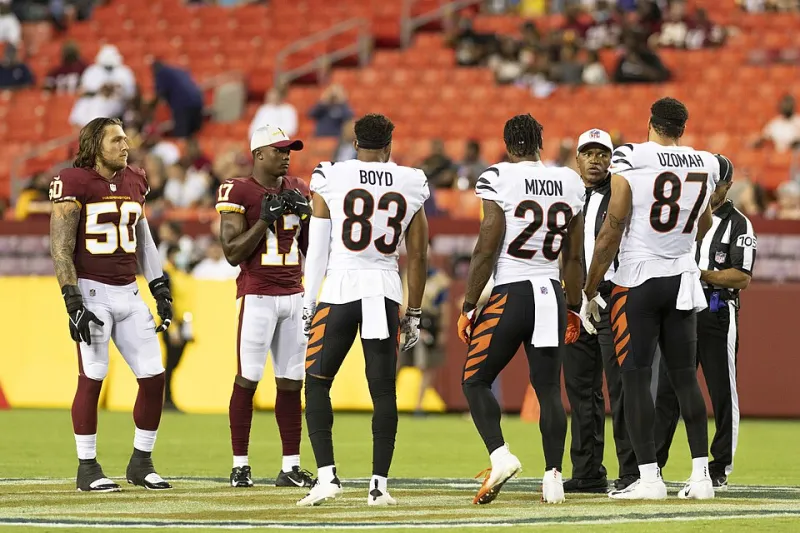
Photo: All-Pro Reels from District of Columbia, USA, CC BY-SA 2.0, via Wikimedia Commons
There is a moment, roughly ninety seconds before kick-off, when twenty-two players, three officials and a mascot who has peaked too early all stand around waiting for a man in black to flip a disc of metal into the air. The whole thing takes four seconds. Nobody claps. Most of the ground is still queueing for the toilet.
And yet in those four seconds, a captain makes a decision that shapes the next 45 minutes of football — sometimes the next 90 — and almost nobody inside the stadium, including the captain, seems to have thought about it since about 2009.
What the toss actually decides
Worth restating, because plenty of seasoned matchgoers still get it slightly wrong. The winner of the toss chooses one of two things: to take the kick-off, or to pick which end their team attacks in the first half. Whatever they don't choose, the other captain gets.
That second clause is where it gets interesting, and where the ritual gets muddled. Because the toss winner cannot simply announce "we'll be shooting towards our end in the second half." If they opt to choose ends, the opponent takes the kick-off — and the second-half end is the automatic consequence of the first-half one. So the popular captain's line, delivered with a grin to the cameras, is really an admission that he's handing the ball to the other lot and hoping they don't do anything clever with it.
Half the time, of course, that's fine. The other half, you're giving a possession-hungry side the kick-off and the ball in your half inside fifteen seconds, which in the modern Premier League is basically an invitation to a set-piece routine.
The stuff nobody mentions in the huddle
Ends matter for reasons that aren't sentimental, and most of them are weather-dependent. A west-facing main stand means a low sun in the eyes of anyone defending that goal on a clear November afternoon — the sort of glare that turns a routine clearance into a comedy header conceded from a corner. Afternoons in this country being what they are, that's not a hypothetical; it's a fixture-list problem.
Then there's wind, which at the more exposed grounds turns one end into a genuine disadvantage for long diagonals and anything struck from range. There's the old-fashioned slope, still there in spirit at a handful of grounds even if the surveyors have flattened the worst of it. There's shadow — the part of the pitch that falls into dusk forty minutes before the rest, where a keeper loses the flight of a floated cross.
And there's noise. If your plan is to start fast, pin the opposition back and get the crowd up, then attacking the big stand in the first half has a logic to it that has nothing to do with tradition and everything to do with momentum. If your plan is to be 0-0 at the break and grow into it, you might actually want the quiet end first.
Nobody is suggesting these are worth three points on their own. They're worth a percent, maybe two — which is precisely the currency that Premier League clubs trade in everywhere else.
The second-half end is a marketing decision
Here's the tell. Ask a captain why he chose an end and you'll usually hear some version of: "It's nice for the fans, they like us shooting that way second half."
Which is a lovely sentiment and a slightly odd one for a professional athlete to prioritise over, say, not defending into a setting sun. The convention has become self-reinforcing: clubs assume supporters want the traditional second-half end, supporters assume it matters, and so the decision gets made by custom rather than by anyone walking to the edge of the pitch at 2:40pm and looking up at the sky.
Compare that with the fuss made over a throw-in routine. Clubs employ specialist coaches to shave minutes off set-piece delivery. Analysts compile dossiers on a reserve left-back's body shape when receiving on the half-turn. And then the coin goes up and the skipper calls "tails" because it rhymes with something.
The one toss with genuine stakes
Penalty shootouts are the exception, and that's where the debate actually lives. Win the toss there and you choose whether to go first or second — a decision with a documented psychological edge, or at least a much-contested one. The research has swung back and forth over the years, but the practical point stands: going first puts the other lot in chase mode, and chase mode misses.
Yet even in shootouts you'll see captains win the toss and look momentarily baffled about what they've won, as if they've been handed a raffle prize and can't find the label. It's the same four seconds, just with considerably more riding on it.
Why it stays uncoached
Partly because it's unquantifiable in any satisfying way. You can't A/B test a coin toss across a season; you get 38 of them and no control group. Partly because it's the captain's moment, and no manager wants to be seen micromanaging the pre-match handshake. And partly because British football has a deep cultural suspicion of marginal-gains thinking — the sense that if you're worrying about the direction of the sun, you've probably lost the plot tactically.
That suspicion is expensive. The clubs at the top of the table have spent a decade industrialising every small edge: sleep, travel, throw-ins, the exact angle of a warm-up cone. Leaving a genuine in-game variable to a coin and a reflex is a small inefficiency, but small inefficiencies are how you end up eighth instead of sixth.
A four-second ask
So here's a modest proposal for 2026-27. Before the toss, the captain gets thirty seconds from the fourth official with the weather app open, a note on which end has the glare, and a one-line instruction from the analyst about what the manager wants out of the first 15 minutes. Then he calls. Then he chooses on purpose.
It won't make headlines. It won't make the highlights. But the next time your centre-half misjudges a long ball into a low winter sun and the ground groans, you'll at least know where the blame starts — and it won't be with the coin.