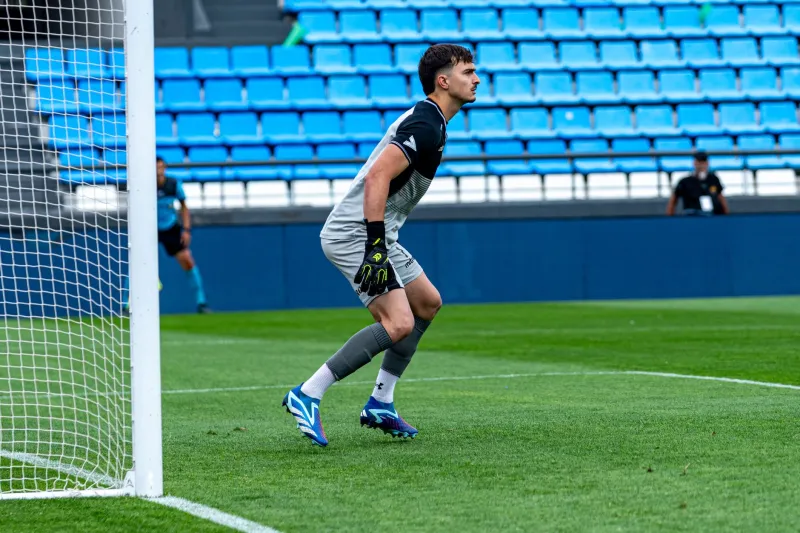
Read the Fine Print: The Loan Derby and Football's Most Awkward Ninety Minutes
Photo: Froztbyte, CC BY-SA 4.0, via Wikimedia Commons
There is a specific noise a Premier League ground makes when a loanee scores against his parent club. It isn't a roar. It's a roar with a question mark in it.
Half the stand is celebrating, half is checking whether the goal is going to be disallowed for a clause, and the player himself is doing the worst thing a footballer can do in that moment: thinking.
Loan fixtures are the least-discussed, most-quoted part of the modern transfer market. Everyone knows the phrase 'cannot play against his parent club'. Almost nobody knows where it comes from, what it actually covers, or why so many of these matches end up more interesting than the actual football.
The Clause Nobody Reads
The rule, such as it is, is that a loan agreement between two Premier League clubs almost always includes some restriction on the player turning out against the parent club. But it isn't a league rule — it's a contractual one. Which means every deal is different, and that is where the fun starts.
At one end you have an outright block: he doesn't travel, he doesn't train that week, he watches from home like the rest of us. At the other end, a club will happily let him play because, frankly, the data they'll collect is worth more than the three points.
Between those two poles sits every awkward variation you can imagine — play but not in the reverse fixture, play but not as captain, play the first 60 minutes only. Some agreements quietly require the parent club to be notified of an injury before anyone else. Some contain a gentleman's agreement that says nothing at all, which is the most chaotic version available to a professional industry.
Can He Even Play?
When the answer is yes, the pre-match press conference becomes a riddle. The manager doesn't want to talk about it. The player, who is usually 21 and desperate to just play football, is asked six questions about loyalty in four different accents.
Ask a supporter and you get a clearer view. Fans of the loaning club are split down the middle, permanently. Half think letting him play is the fair, sporting thing to do. Half think it's an own goal waiting to be scored, and they are usually the half that turns out to be right, because that's how these things work.
Fans of the parent club, meanwhile, have no emotional skin in it whatsoever until the teamsheet drops — at which point they all suddenly become very invested in the health of a player most of them have never seen play live.
The Celebration Problem
This is the real etiquette. Everything else is paperwork.
Football's unwritten code says you don't celebrate against your parent club. The code is enforced by roughly 40,000 people and a slow-motion replay. A loanee who runs to the corner and slides on his knees against the club that owns his registration is not committing a crime, and yet it will follow him around for years.
In 2026-27 the etiquette has got muddier, not cleaner. Players move more, on shorter loans, in a more transactional game. The idea that a 22-year-old should feel a deep loyalty to a club that shipped him out on deadline day to a team 200 miles away is a romantic one, and romance is not especially fashionable in the transfer market.
What you notice most is the body language. The arms-out, no-celebration apology, palms flat, apologising to nobody in particular. Every one of those looks the same. It's become a small piece of modern football theatre, like a manager pretending not to know the fourth official.
Who Gets the Data?
Here is the part supporters rarely consider. In a loan deal, the parent club is usually still watching everything.
Load data, sprint data, positional heat maps, medical updates, training attendance — most of it flows back automatically in 2026-27, because both clubs use the same platform and the player traces as an asset in an asset-management exercise. Which means a loanee's parent club knows three days before the fixture whether he's going to be sharp.
That has produced a modern oddity: the parent club's analysts effectively prepping for a player who is theirs. You can argue this is useful, and you can also argue it's a bit like your landlord reading your diary.
What the Parent Club Is Actually Watching
The playing-and-data question distracts from the genuinely interesting one. For a parent club, this fixture is not about the result. It's an audition and a risk assessment at the same time.
They are watching whether he can handle a crowd that half knows him. Whether he goes missing in the first 15 minutes when the away end sings his name sarcastically. Whether he takes a penalty if one comes. Whether he takes it well.
And they are watching whether the manager who has him on loan trusts him in a big game. This matters more than people think. A loanee stuck on the bench for the fixture against his parent club has, quietly, failed a test. A loanee who starts and does nothing wrong has passed it. A loanee who scores and refuses to celebrate has booked himself a conversation in the summer.
The Awkward Bit
Afterwards, in the tunnel, there's a small reunion. Players who shared a dressing room for six weeks in pre-season shake hands with genuine warmth. Often the loanee hugs a coach who barely remembers his name. It is the least Premier League thing you will see all season, and it's the reason these games are worth watching.
Because the loan system is football's least glamorous machine — engineered, contractual, brutal in its economics — and about four times a year it accidentally produces a moment of pure human discomfort in front of a television audience of millions.
Most of the time, the clause works, the player doesn't play, and nobody thinks about it again. But when it doesn't — when the fine print says yes — you get a game nobody on the marketing team planned for, and a player trying to do a job for one employer while being watched very closely by another.
The fans, as ever, see it clearest. When the loanee is through on goal and the whole ground draws breath together, everybody already knows what the outcome means, and nobody has read the contract except two people in a boardroom.
That's the loan derby. Ninety minutes of football, and about 12 months of paperwork happening very quietly behind it.