Twenty-Two Shirts and One Emergency Needle: A Morning Inside the Premier League Kit Room
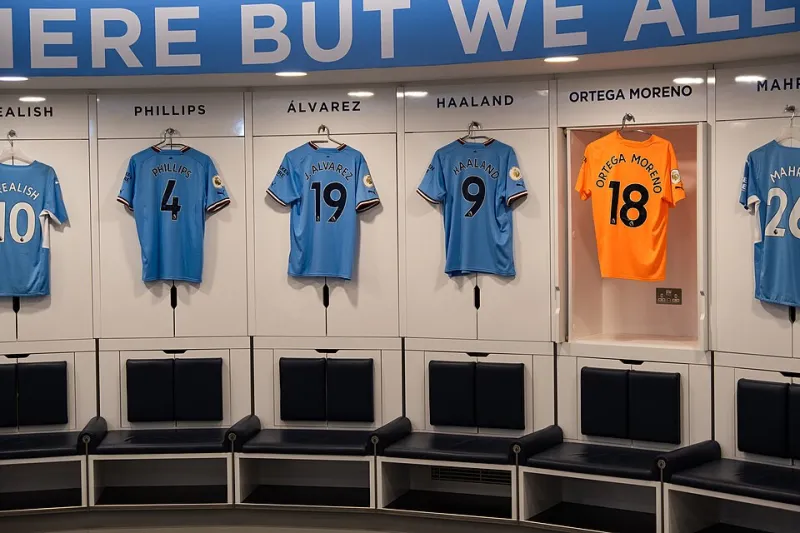
Photo: Christian David, CC BY-SA 4.0, via Wikimedia Commons
You get to the ground about an hour and a half before kick-off. The kits are already hanging. They look like they've been there since Thursday.
They haven't. They got there at about half six this morning, on a trolley, from a room that smells of detergent, deep heat and faintly of someone's bacon sandwich.
Six in the Morning, Door 14
The kit room at a Premier League club is not a room, in the way that a stadium isn't really a building. It's a junction. Everything passes through it: players, physios, coaches, the odd director who has lost a coat, a courier with a box of boots that arrived from Portugal at 4am.
On a matchday, the work starts roughly five hours before kick-off and finishes about two hours after. In between, it is the only department in the club where a single misplaced item can delay a warm-up, embarrass a player in front of 60,000 people, or — the true nightmare — put a 19-year-old in the wrong shade of sock for his debut photo that will live on the internet forever.
What Actually Goes Out
For a league away trip, the numbers are absurd. Twenty-plus full outfield sets as standard. Two or three goalkeeper sets, in two colourways, because you cannot guarantee what the opposition will wear and you absolutely cannot guarantee what the officials will turn up in. Spare shirts in three sizes. Two sets of warm-up kit. Training tops. Bibs. Match balls, training balls, the specific ball the goalkeeping coach insists on.
Then there's the name-set problem. Every shirt is printed, not stitched, and the printing happens in-house, usually on the Friday. Names arrive late, spelling gets queried, one player wants the accent, another wants it dropped. In 2026-27, with more hyphenated double-barrelled surnames in the league than ever, the spreadsheet that used to be a Post-it note is now a small IT project.
A misplaced letter on a match shirt is not a small thing. It becomes a photograph, then a meme, then a question in a post-match press conference.
The Sock Problem
Ask anyone who does this job and they will tell you: the missing sock is the true emergency.
A missing shirt can be borrowed from the club shop stock. A missing pair of shorts is annoying but solvable. A missing sock, on a matchday, 40 minutes before kick-off, is a genuine operational crisis — because socks are size-specific, colour-specific, and the officials will notice if one player is wearing a slightly different navy.
So the good kit rooms hold an emergency drawer. Not a shelf — a drawer, and it is guarded like a war room. Odd socks of every colourway, in every size, plus two spare sets of shin pads and a tin of studs. The drawer is where you find out whether a department is well run. If someone can put their hand on a size 9 white sock in eight seconds, they are professionals. If they start opening cupboard doors and saying 'we definitely had one', you are going to have a bad afternoon.
The Repair Kit and the Ritual
Somewhere in every kit room is a small box that looks like it belongs in a school art cupboard and is treated with far more reverence. Needle. Thread. Fabric glue. A spare iron-on number. Scissors that only cut fabric and will cause an argument if used for anything else.
Players go down in warm-ups. Shirts split at the seam. A boot blade comes loose. The kit staff are, quietly, the least-credited repair technicians in British sport. They will also, if asked nicely, sew a lucky patch inside a shirt that a player insists on keeping from a club he left three seasons ago. That sort of thing doesn't show up in a transfer fee report, but it's part of a squad's sense of self.
The Laundry Question
Nobody outside the building thinks about the wash cycles. Inside, it is the whole morning.
Three or four industrial machines, loaded by colour and fabric, on a schedule timed so that the last set is dry exactly when the coach leaves. Hot washes shrink modern kits. Wrong detergent ruins the printing. Overloading the dryer fades the badge. There is an entire oral tradition of kit-room knowledge about which club's shirt loses its colour first, and it gets passed around the league like folk wisdom.
At some clubs, the wash is a full-time department. At others, the kit manager is doing it at 11pm the night before, alone, listening to a podcast. Both exist in the Premier League in 2026-27. That gap tells you more about a club than the new training ground ever will.
What the Kit Room Says About a Club
Here is the unfashionable point. The kit room is one of the few departments where everyone in the building is a customer — the £300,000-a-week forward and the under-18 making his first trip are equally dependent on the same two people remembering the right size.
So you learn things. You learn which players say thank you and which ones don't. You learn which manager asks for his staff's names, and which one has been at the club two years and still calls everyone 'mate'. You learn whether the club will pay for a second industrial dryer or whether someone is going to spend their Saturday morning watching a spin cycle while the analysts are still in bed.
And you learn that the culture of a football club, the thing pundits talk about endlessly and can never quite define, is mostly a set of small acts of reliability performed by people who are never on television.
The Bit Nobody Films
After the final whistle, the kit room gets busy again. Shirts come back in bags, wet, sometimes not entirely identifiable without checking the number. Sweat-soaked, grass-stained, occasionally torn. Then it's a wash, a sort, a count, a note on the sheet about what needs replacing.
By nine in the evening, the ground is dark and the kits are hanging again, ready for a Tuesday. Nobody claps. Nobody should have to. But next time you see a pre-match shot of the dressing room, all neatly laid out in perfect rows, remember it's not the gesture of a big-budget operation.
It's somebody's Friday night.