Lens on the Lads: The Away End Has a Camera Now — and That Is Not the End of the World
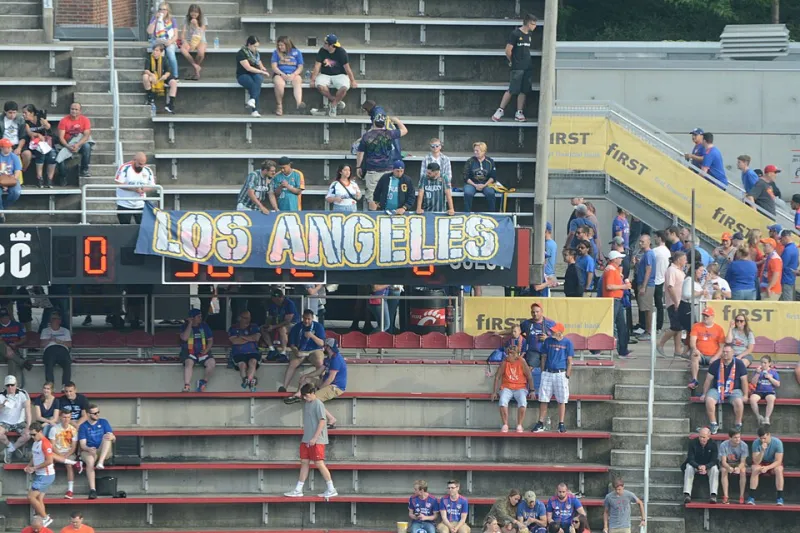
Photo: Hayden Schiff from Cincinnati, USA, CC BY 2.0, via Wikimedia Commons
Picture the away end at 2:55pm on a Saturday. The concourse smells of lager and chips, someone is trying to start a song three rows too early, and at least four people are checking their camera angles. The scarves are still there. So are the phones. In 2026, filming is not something that happens around away support. It is part of away support.
That shift makes people uncomfortable, and you can see why. The traditional image of a Premier League away day is raw, loud and slightly chaotic. A bloke holding a phone above his head while the rest of the row is trying to watch a corner does not fit that picture. But the argument that phones are killing matchday atmosphere is too simple. The truth is messier, funnier and more interesting: the phone has become the new scarfer. It is a badge of identity, a way of saying I was there, and a tool for sharing the thing that makes away days worth the train fare.
The phone was always coming
For a generation of supporters, filming is not a separate act from supporting. It is part of the ritual. You film the walk to the ground, the pub, the concourse, the teams coming out, the goal, the limbs, the full-time whistle and the slightly surreal train home. None of that is new in spirit. Fans have always collected away-day stories. The phone has just made the collection instant.
If you have ever tried to explain an away end to someone who has never done one, you will understand why people film. You cannot really describe the noise when a last-minute equaliser goes in. You can try, and you will sound like a man reviewing a firework display. A clip does some of the work. It is not the same as being there, but it is a decent note to yourself and a decent advert for the next trip.
The phone is not replacing the scarfer. It is joining it. The scarf says who you are. The phone says what it felt like. That is not automatically a problem.
What the stewards actually see
Stewards are caught in the middle of all this, and they deserve more sympathy than they get. Ground regulations are not written for a world where every second supporter has a 4K camera in their pocket. Clubs want to control filming rights, protect safety and stop people blocking aisles. Fans want to capture the moment they have paid £70 and travelled four hours to experience. The steward on the gangway is the person who has to referee that argument in real time.
Most stewards are not anti-phone. They are anti-blockage. There is a difference. The lad holding a phone above his head in row 12 is annoying, but he is not a public order emergency. The vlogger with a gimbal, a microphone and a small production crew is a different matter. He might be harmless, but he is also a walking trip hazard with a ring light.
The inconsistency is the real issue. One steward tells you to put the phone away; another poses for a selfie. One club allows fan media; another treats a small camera like contraband. Supporters pick up on that quickly. If the rules feel arbitrary, people stop respecting them. If the rules are clear, most fans will meet them. The away end is not a lawless zone, but it is a place where common sense travels further than a laminated sign.
The clubs are quietly monetising it
Here is the contradiction at the heart of the debate. The same club that frowns at a phone in row 12 will happily repost a fan clip on its social channels an hour after full-time. The same media team that cannot officially endorse filming in the stand knows exactly how far a good away-end video can travel. Clubs are not stupid. They can see the reach.
Some are already moving beyond reposts. Fan media programmes, creator accreditation for selected fixtures and informal relationships with trusted vloggers are becoming more common. It is not a revolution, and it is not uniform across all 20 clubs, but the direction of travel is obvious. Clubs want the authenticity of fan content without the liability of uncontrolled filming. Creators want access without being treated like a nuisance. Fans want to watch the thing they just sang about.
That is not necessarily a sell-out. It is a negotiation. The problem is that the negotiation is often happening in private while the stewarding policy in the stand remains stuck in the past. If clubs are going to use the footage, they should be honest about the rules that produce it.
The atmosphere argument is more complicated
Does filming kill atmosphere? Sometimes, yes. There is a certain type of supporter who watches the whole match through a screen and then wonders why the noise never got going. There is also a certain type of vlogger who performs for the camera rather than joining in. You know the face. It is the one that says this is content rather than this is a football match.
But phones also amplify atmosphere. A good away end now travels further than the 3,000 people inside the ground. Clips of limbs, flags and full-time scenes inspire other fans to book trains. They preserve the weird little rituals that make English away support distinctive. They give younger supporters a way into a culture that can otherwise feel closed and intimidating.
The atmosphere is not being replaced by a screen. It is being distributed. That distribution has costs, especially around safety and consent, but it also has benefits. A blanket ban would not restore some imagined 1990s away end. It would just drive the filming underground and make clubs look out of touch.
What clubs should do instead of banning it
Stop treating the phone as contraband. Start treating it like standing: something that needs managing, not criminalising. Clear, simple rules would help. Personal filming is fine if you are not blocking an aisle, a gangway or someone's view. Gimbal rigs and tripods need permission. Filming in toilets, medical incidents or people having a bad time is not on. Those rules are not difficult to write.
Steward training matters more than posters. Stewards should be able to tell the difference between a kid filming a goal and a creator setting up a shot in a fire exit. Clubs should work with away fan groups and fan media on what works, rather than announcing a policy from a boardroom and hoping it lands. A designated filming area is probably impractical in most old grounds, but a designated attitude is not.
The away end has always changed. It changed with seating, with all-seater stadiums, with ticket prices, with mobile phones. The culture did not die. It adapted. The phone is the new scarfer, and the clubs should stop pretending it is the enemy. Manage it, talk to the people doing it, and let the away end be what it is: loud, messy and occasionally vertical. Just ask the person behind you to hold it steady.